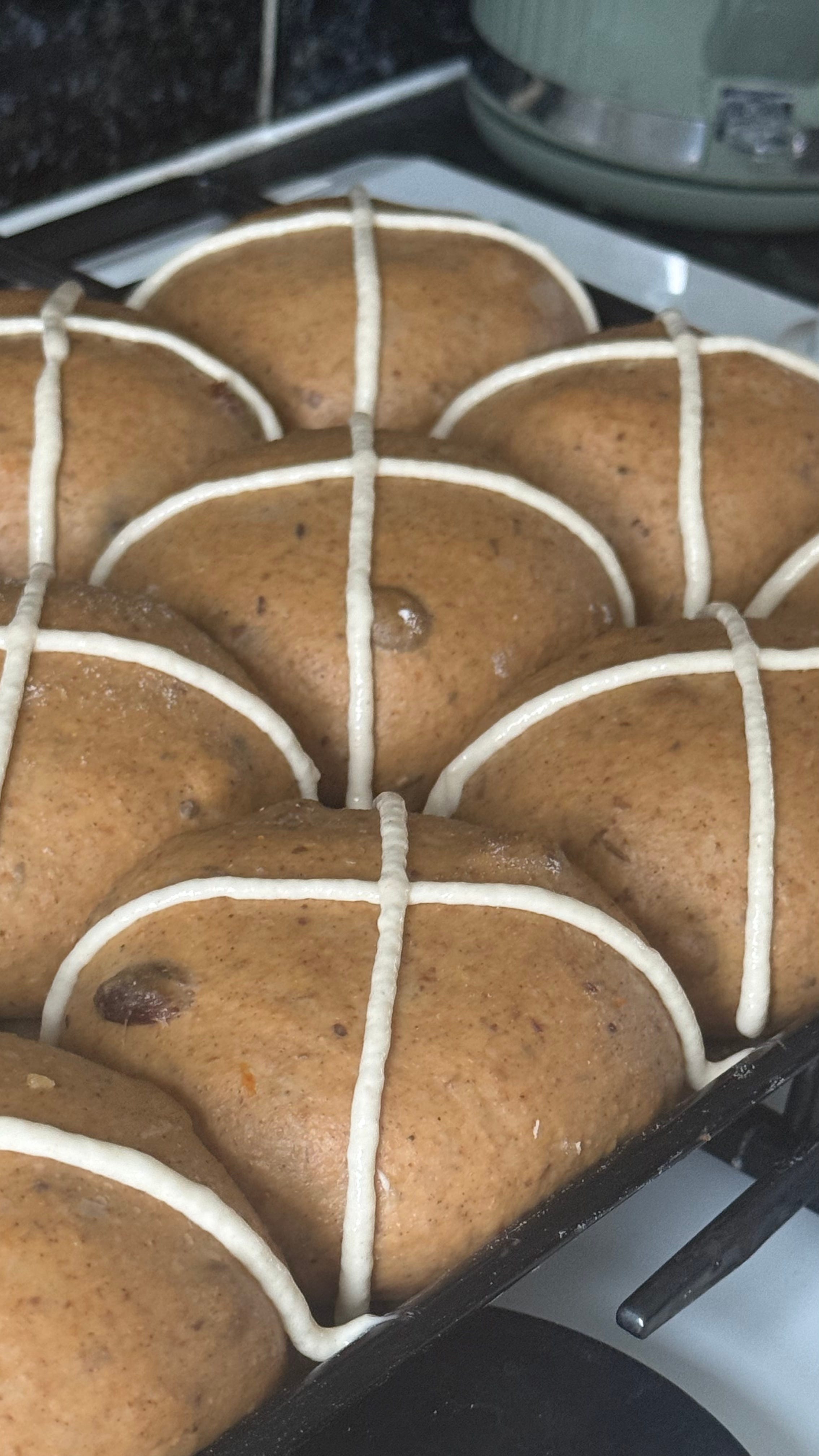
this year's HXB recipe
with earl grey and prunes

What I’m reading: Ordinary Saints by Niamh Ní Mhaoileoin - I’m only halfway through this, but currently really enjoying. It’s a novel about a queer Irish woman living in London whose brother is a candidate for (literal) Catholic sainthood - so far, so entertaining
What I’m listening to: Joshua Burnside’s newest album, It’s Not Going to be Okay
What I’m eating: lots of delicious French and Italian alpine food while skiing last week (below). Everything tastes better at altitude!!


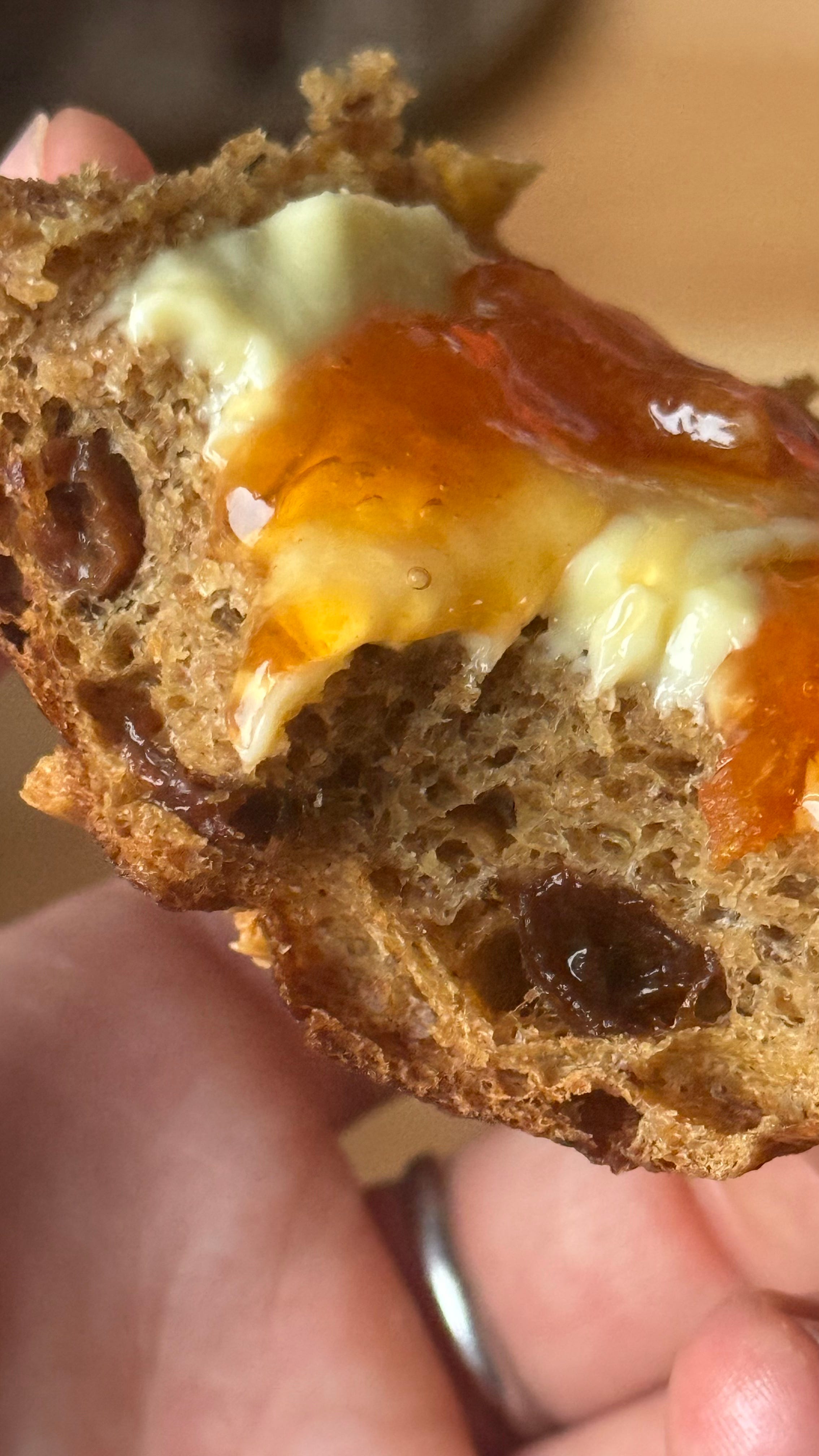
It’s hot cross bun season! I really love this time of year: it’s been really bright and sunny in London (and it’s about to get brighter thanks to daylight savings time this weekend), daffodils are OUT and springtime produce (asparagus, strawberries, peas) is starting to appear. Although Easter is a religious holiday (and I don’t count myself among the faithful), it’s hard to argue with a holiday whose key dates are marked by baked goods: Pancake Tuesday for the beginning of Lent, chocolate to celebrate Easter Sunday, and hot cross buns for the interim period - or more specifically, on Good Friday, to commemorate the crucifixion of Jesus. This is a somewhat morbid association, and I gently encourage you to detach the traditional significance from the food, and enjoy it for what it is: a soft, delicately spiced bun, filled with aromatic fruit and plenty of citrus, perfectly glazed and enjoyed fresh or toasted - preferably with butter and jam
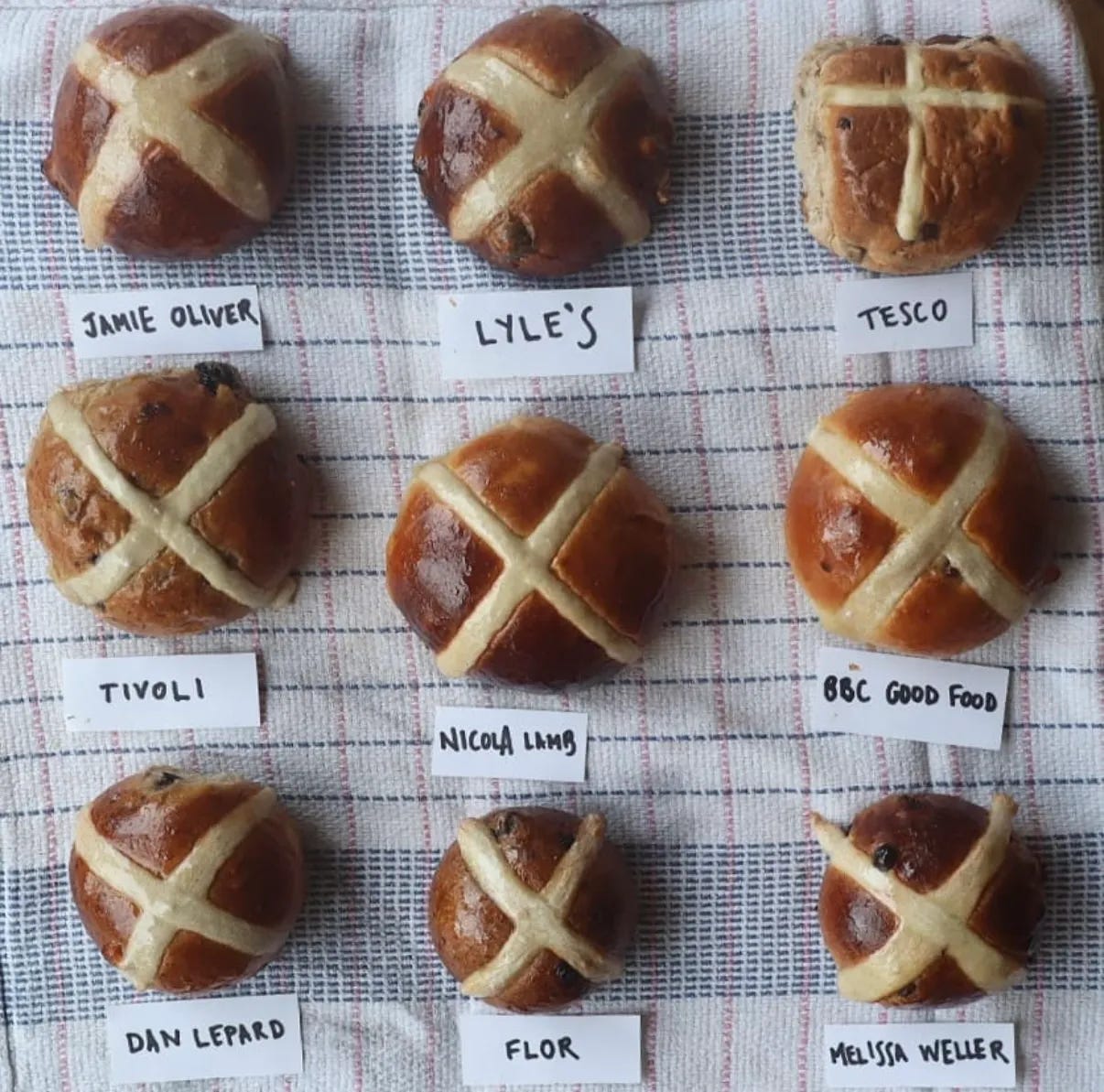
Made well, hot cross buns should be soft and springy, richly spiced and filled with plump dried fruit. They should be fragrant with orange, glazed, and inscribed with the distinctive cross (that, although it adds nothing to the flavour or texture, is essential to the experience). If not eaten fresh (as in, on the day they are baked), hot cross buns should almost always be toasted - but be careful when putting them in your toaster. If they are too tall, or the glaze catches on the grates of the toaster, the bun might catch and burn. I haven’t personally tried this, but I can also imagine HXB being the perfect vessel for cheese, so don’t be alarmed if you see buns on my cheeseboard this Easter. This year, I’ve been turning leftover HXB into French toast (see below), with bacon and maple syrup and I enjoy it so much that I’m planning on stocking my freezer so I can continue doing this for months to come.
A little bit of hot cross bun history
I had always thought that hot cross buns had Christian origins - a fairly safe guess due to the crucifix on top and the fact that we eat them around Easter. However, after a little bit of research, it seems that HXB actually have pagan origins - in ancient Britain. The Saxons used to bake buns to celebrate springtime, and to honour the ancient pagan goddess of dawn and fertility, Eostre. This may actually be where the word “Easter” comes from.
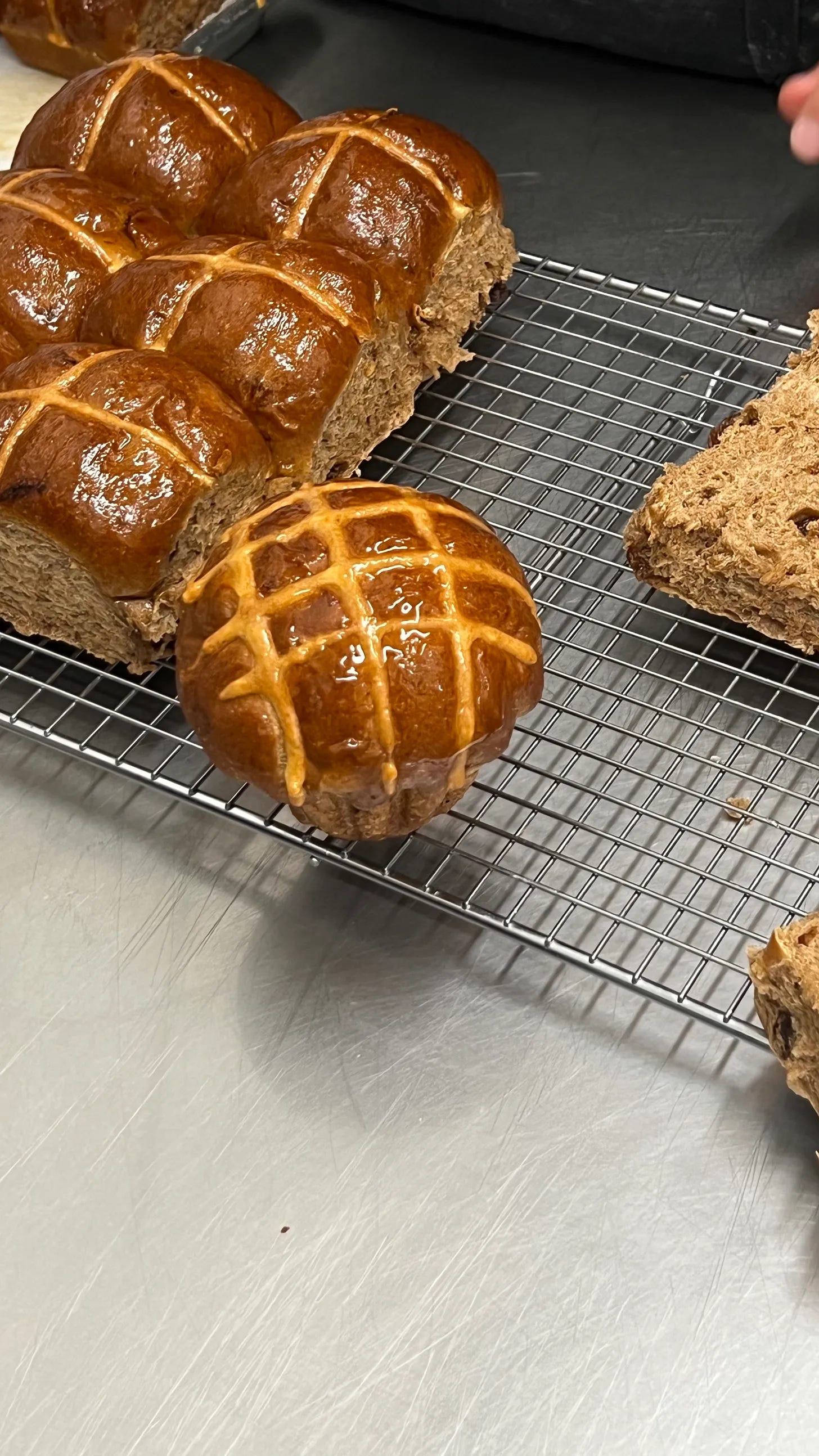
If HXB do pre-date Christianity, then it is likely that they were adopted as a Christian tradition, and presented as an Easter treat which conveniently includes many ingredients forbidden during Lent, a period of abstinence. In fact, I’ve recently discovered that Good Friday is supposed to be the main day for HXB consumption - again, this tracks with my assumption of Christian origin (Good Friday is when Jesus was allegedly crucified, died and was buried).
For some inexplicable reason, during the reigns of Elizabeth I and James I (16th and 17th century ish), a decree was issued in the UK which forbade the commercial sale of HXB - except at Easter, Christmas, and at funerals. This led to an increase in the production of HXB in home kitchens (and I like to imagine also a black market for buns - but that’s pure conjecture). The secrecy surrounding the baking of HXB led to an air of mystery which fuelled superstition. Hot cross buns were said to contain healing powers, and some said that HXB baked on Good Friday would never go mouldy. What’s more, sailors started bringing HXB on board, believing that they would prevent shipwreck.
During the Victorian era, HXB began to resemble more closely the buns we know and love today. Currants or raisins and spices such as cinnamon and nutmeg were added, and street vendors began selling them warm from the oven all over the UK (“one a penny” if they were bigger, “two a penny” for smaller ones). This line originally appears in Poor Robin’s Almanac in 1733, and later in a nursery rhyme in the London Chronicle in 1767.
recipe: earl grey and prune HXB
If you’re familiar with enriched doughs (brioche, milk bread etc.), you should find this recipe pretty easy to follow. The differences are in the aromatics and flavourings: I’ve gone for a blend of flours, a lovely warm spice mix and whole boiled pureed orange (as well as orange zest). This year, I’ve also added some earl grey infused prunes, which do wonders for the texture (and fibre content), not to mention the lovely aromatic flavours which complement the orange so well. If you have a good marmalade to hand, I recommend slathering it on these (as well as a healthy amount of salted butter). Below the recipe, you’ll find my advice for turning leftover HXB into French toast - something that I really strongly recommend. Bon app x